Brockhurst Resident
Captain Francis Sandys Dugmore
1839 – 1898
Of all the lives connected to Brockhurst, none is more extraordinary — or more sobering — than that of Captain Francis Sandys Dugmore. Soldier, husband of an aristocrat, agitator, African adventurer, and finally murderer: Dugmore's story unfolded across three continents over six tumultuous decades, ending in a prison cell in Mombasa in November 1898, covered up by a sentence in a colonial gazette.
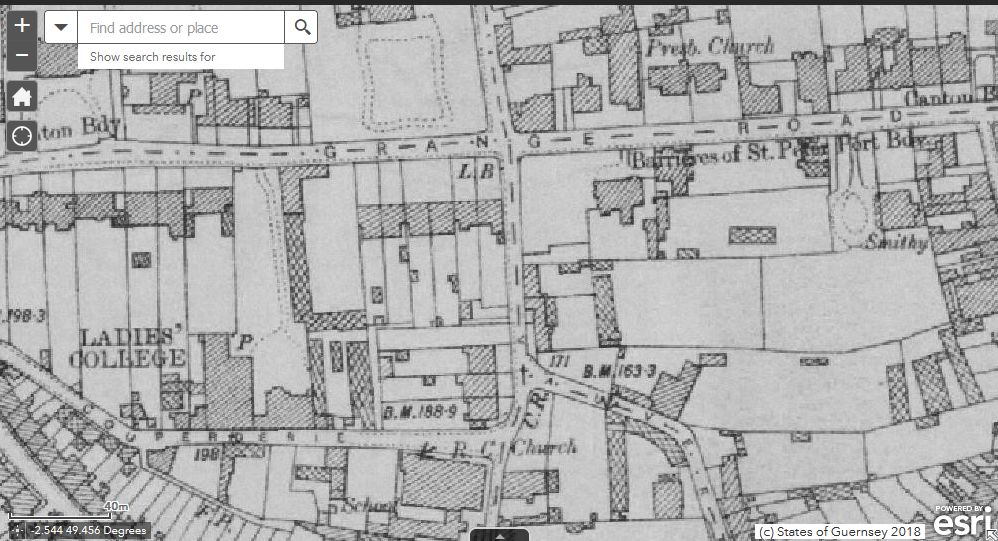
His wife, the Hon. Emily Evelyn Brougham, meanwhile lived quietly at Brockhurst on The Grange in St Peter Port, outliving him by twenty-one years.
The Soldier
Francis Sandys Dugmore was born in Paddington, London, in 1839, the son of a barrister. He entered the army at a young age and served first with the Royal Canadian Rifle Regiment, giving him early experience of the Canadian frontier — a posting that would later shape his sense of adventure. He rose to the rank of Captain in the 64th Regiment of Foot, a distinguished infantry regiment with a long history of service in the British Empire.
On 23 April 1867, he married Emily Evelyn Brougham, daughter of William Brougham, 2nd Baron Brougham and Vaux, and great-niece of the celebrated Lord High Chancellor Henry Brougham. The match was a good one: the Broughams were among the most prominent Whig families in Britain. The couple settled first in Canada, where their eldest son William was born, and later at Dauddyffryn in Merionethshire, Wales. Together they had five children: William, Arthur, Wilfrid, Cyril, and a daughter, Louisa.
Dugmore retired from active army service in July 1882 and was placed on the reserve list. To all appearances, he was a respectable Victorian officer entering a genteel retirement.
Ireland, 1882
Within months of retiring, Dugmore had made himself notorious. In 1882 — the height of the Irish Land War — he was imprisoned in Tullamore Gaol for inciting tenants not to pay their rents. Questions were raised about the propriety of his imprisonment in the House of Commons; he was eventually released, but the episode marked him as a man who operated outside the boundaries of conventional respectability.
Whether the marriage began to deteriorate at this point is not recorded. What is clear is that by1891, the census recorded Emily living at Brockhurst on The Grange, Guernsey, described as “living on private means” — with two of their youngest sons beside her, and Dugmore recorded elsewhere.
The Freelanders' Expedition, 1894
In 1889, an Austrian economist named Theodore Hertzka published a utopian novel called Frieland, which proposed the establishment of a communal colony in East Africa where members would work according to their ability and be rewarded according to their needs. The book attracted a devoted following across Europe. The British Freeland Association approached the Imperial British East Africa Company in 1894 to establish such a colony near Mount Kenya.
The first contingent of sixteen colonists — described by one historian as “a bizarre assortment including German, Austrian and British anarchists, along with a Russian, a New Zealand seaman, and a serving Austrian army officer” — sailed from Hamburg on 28 February 1894. Alfred Russel Wallace, the co-discoverer of evolution by natural selection, had lent his name to the enterprise. Even so, the scheme proved a ludicrous failure: the equatorial terrain was hostile, the logistics were disastrous, and the colony never established itself.
Dugmore was among those who joined the expedition. Unlike most of his fellow colonists, he did not return home when the venture collapsed.
East Africa, 1894–1898
After the Freelanders disbanded, Dugmore attached himself to British troops at Mwele and declared himself a war correspondent. He then secured a minor post in Mombasa before being appointed, in September 1896, to command Sudanese troops at the Ngong stockade outside Nairobi.
By this stage his behaviour had become markedly erratic. Rather than speaking to colleagues face to face, he would type them lengthy letters, which he signed “Mugdore Ye Looniac” or, on occasion, with phrases so profane that the District Commissioner John Ainsworth considered them unprintable. He soaked his pyjamas in paraffin to combat fleas — giving himself boils across his body. He flogged his pet monkey. Those around him found him, in Ainsworth's measured words, “extraordinarily difficult” and “decidedly strange.”
In August 1898 he returned from involvement in suppressing the Sudanese mutiny in Uganda, only to find that his post had been filled by another man: William Cooke.
The Athi River, August 1898
During a journey to Machakos, Dugmore and Cooke made camp at a halt on the Athi River. A dispute arose over the positioning of their tents — a trivial matter that, in Dugmore's deteriorating mental state, apparently assumed the weight of the usurpation of his entire position.
He seized Cooke's loaded rifle and shot him dead.
Dugmore was arrested and transported to Mombasa to await trial for murder.
Death and Cover-up, November 1898
He never stood trial. On 10 November 1898, while held in custody in Mombasa, Francis Sandys Dugmore took his own life, using a bootlace. He left effects amounting to just£60.
The Zanzibar Gazette duly recorded his death. The cause given was apoplexy. No mention was made of the murder, the arrest, or the manner of his death. The imperial machinery of colonial record-keeping had quietly closed over the case of Captain Francis Sandys Dugmore, and that was where the matter rested for many decades.
Aftermath
Emily Evelyn Brougham, who had been living at Brockhurst through all of this, continued to reside on The Grange in St Peter Port. She outlived her estranged husband by twenty-one years, dying in Guernsey on 13 November 1919.
Of their sons, the eldest — William — pursued a military career and was killed in action in 1917 during the First World War. Another son became an accomplished photographer; another an athlete. Their daughter Louisa's fate is not recorded.
The full story was eventually recovered by historian Christine Nicholls, whose research in colonial archives brought the details to light more than a century after Dugmore's death. Without that work, the Zanzibar Gazette's tidy fiction of apoplexy might have stood unchallenged.
Captain Dugmore and the Hon. Emily Brougham appear in the Brockhurst timeline during the Victorian era.
Back to Brockhurst Timeline