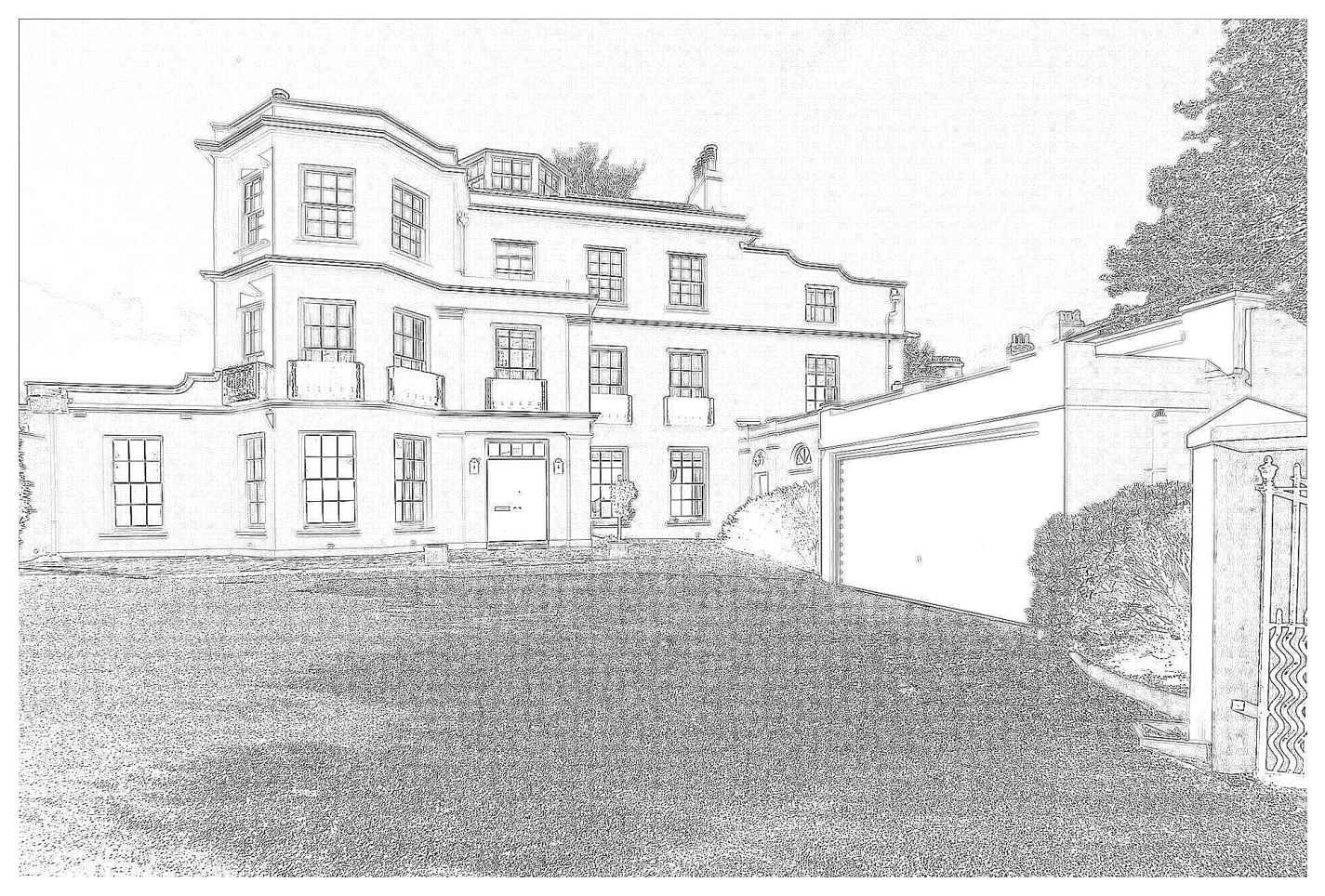
Timeline of Brockhurst Residents and Historical Events
Circa 1740 until present day
Originally built around 1740, Brockhurst was first owned by the Brock family, historically significant to Guernsey.
Brockhurst: Notable Residents
Construction of Brockhurst
House built by William Brock (1702–1776) as a summer residence on The Grange, St Peter Port.
Construction of Brockhurst
House built by William Brock (1702–1776) as a summer residence on The Grange, St Peter Port.
William Brock
William Brock (1725-1768), first resident owner of Brockhurst, married to Judith de Beauvoir. Oversaw early years of the house's history.
William Brock
William Brock (1725-1768), first resident owner of Brockhurst, married to Judith de Beauvoir. Oversaw early years of the house's history.
Daniel de Lisle Brock
Nephew of William Brock, Daniel was a key figure in Guernsey history. His tenure as owner coincided with his Bailiffship, making Brockhurst a centre of Guernsey leadership.
- •Educated partly in Alderney to learn French, then at a school in Richmond, Surrey; at 14 left school to accompany his ailing father to France, later travelling extensively through the Mediterranean, Switzerland, and France.
- •Elected Jurat in 1798, from which point his name became intimately associated with Guernsey's history.
- •Dispatched four times to London (1804–1810) to defend Guernsey's trade privileges and ancient rights before Parliament.
- •Appointed Bailiff of Guernsey in 1821, following the death of Sir Peter de Havilland.
- •In 1821, successfully defeated proposed legislation that would have prevented Guernsey from importing corn until prices reached 80 shillings.
- •In 1832, resisted the extension of habeas corpus writs to the island, preserving Guernsey's right to be tried in its own courts.
- •In 1835, led a deputation to London opposing the removal of the Channel Islands' right to export corn to England duty-free; a House of Commons Select Committee was appointed and the bill was withdrawn.
- •Initiated monetary reforms, including a state-backed currency, and funded critical infrastructure including new roads and schools.
- •Oversaw the construction of a new Elizabeth College building in 1826, effectively reviving an institution originally founded by Royal Charter from Elizabeth I in 1563 — the college as it stands today.
- •Accorded a public funeral upon his death on 24 September 1842 in recognition of his long service to the island.
- •His portrait appeared on the 1991 States of Guernsey £1 note; his bronze bust adorns the NatWest Bank building on the High Street to this day.
Daniel de Lisle Brock
Nephew of William Brock, Daniel was a key figure in Guernsey history. His tenure as owner coincided with his Bailiffship, making Brockhurst a centre of Guernsey leadership.
- • Educated partly in Alderney to learn French, then at a school in Richmond, Surrey; at 14 left school to accompany his ailing father to France, later travelling extensively through the Mediterranean, Switzerland, and France.
- • Elected Jurat in 1798, from which point his name became intimately associated with Guernsey's history.
- • Dispatched four times to London (1804–1810) to defend Guernsey's trade privileges and ancient rights before Parliament.
- • Appointed Bailiff of Guernsey in 1821, following the death of Sir Peter de Havilland.
- • In 1821, successfully defeated proposed legislation that would have prevented Guernsey from importing corn until prices reached 80 shillings.
- • In 1832, resisted the extension of habeas corpus writs to the island, preserving Guernsey's right to be tried in its own courts.
- • In 1835, led a deputation to London opposing the removal of the Channel Islands' right to export corn to England duty-free; a House of Commons Select Committee was appointed and the bill was withdrawn.
- • Initiated monetary reforms, including a state-backed currency, and funded critical infrastructure including new roads and schools.
- • Oversaw the construction of a new Elizabeth College building in 1826, effectively reviving an institution originally founded by Royal Charter from Elizabeth I in 1563 — the college as it stands today.
- • Accorded a public funeral upon his death on 24 September 1842 in recognition of his long service to the island.
- • His portrait appeared on the 1991 States of Guernsey £1 note; his bronze bust adorns the NatWest Bank building on the High Street to this day.
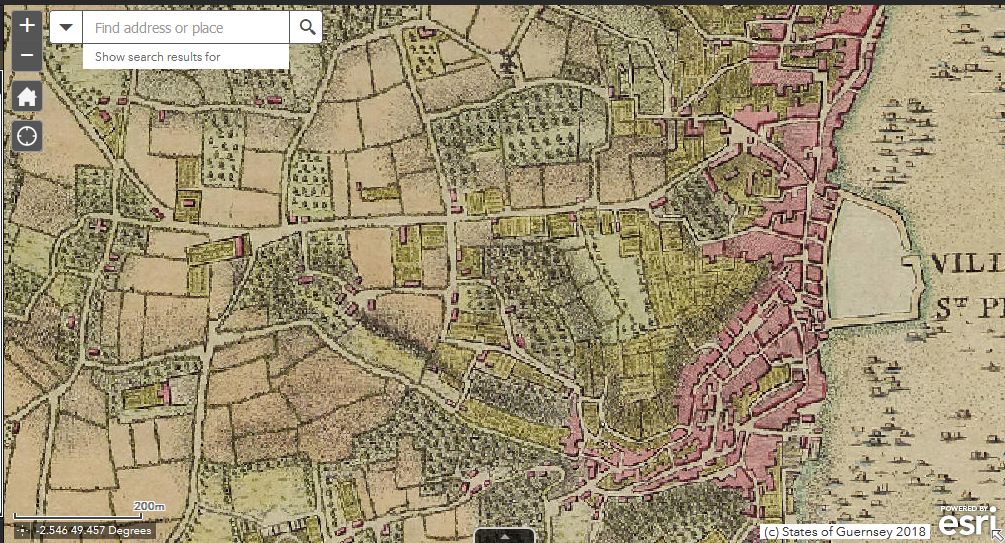
1787 Map of Guernsey - Brockhurst area during Daniel de Lisle Brock's era
Major-General Sir Isaac Brock
Daniel's brother, born 6 October 1769 in St Peter Port as the eighth son of John Brock — a former Royal Navy midshipman. His mother, Elizabeth de Lisle, was the daughter of Guernsey's Lieutenant-Bailiff, giving the family further connections to the island's legal establishment. Renowned as an exceptional swimmer and boxer at school in Guernsey, he was sent to Southampton at age ten and later studied in Rotterdam to improve his French:
- •His childhood home on High Street, St Peter Port (separate from Brockhurst, which was the family's summer residence) still stands, now occupied by Boots the Chemist and marked with a memorial plaque.
- •Commanded British forces in Upper Canada during the War of 1812.
- •Achieved victories, notably at the Battle of Queenston Heights on 13 October 1812, earning the title 'Hero of Upper Canada.'
- •Forged a celebrated alliance with the Shawnee leader Tecumseh; when they met at Amherstburg, Tecumseh reportedly declared 'This is a man!' — and together, using bluff and deception, they forced an American force that outnumbered them to surrender Fort Detroit without a single British life lost.
- •His knighthood was posthumous — he fell in battle before he could be told he had been knighted; Parliament later granted pensions of £200 to each of his four surviving brothers.
- •Honoured extensively in Canada with Brock's Monument on Queenston Heights, Brock University, and numerous place names.
Major-General Sir Isaac Brock
Daniel's brother, born 6 October 1769 in St Peter Port as the eighth son of John Brock — a former Royal Navy midshipman. His mother, Elizabeth de Lisle, was the daughter of Guernsey's Lieutenant-Bailiff, giving the family further connections to the island's legal establishment. Renowned as an exceptional swimmer and boxer at school in Guernsey, he was sent to Southampton at age ten and later studied in Rotterdam to improve his French:
- • His childhood home on High Street, St Peter Port (separate from Brockhurst, which was the family's summer residence) still stands, now occupied by Boots the Chemist and marked with a memorial plaque.
- • Commanded British forces in Upper Canada during the War of 1812.
- • Achieved victories, notably at the Battle of Queenston Heights on 13 October 1812, earning the title 'Hero of Upper Canada.'
- • Forged a celebrated alliance with the Shawnee leader Tecumseh; when they met at Amherstburg, Tecumseh reportedly declared 'This is a man!' — and together, using bluff and deception, they forced an American force that outnumbered them to surrender Fort Detroit without a single British life lost.
- • His knighthood was posthumous — he fell in battle before he could be told he had been knighted; Parliament later granted pensions of £200 to each of his four surviving brothers.
- • Honoured extensively in Canada with Brock's Monument on Queenston Heights, Brock University, and numerous place names.
Sale of Brockhurst
Brockhurst sold by the Brock family to William Le Mesurier & Elizabeth Le Marchant — a pairing that brought together two of Guernsey's most powerful dynasties. The Le Mesurier family were among the island's foremost merchant and privateering families, with ventures reportedly amassing £1 million in prizes during the 18th-century wars; they also governed Alderney as hereditary proprietors for much of the 1700s. The Le Marchant family were equally distinguished on the legal and civic side, having provided four Bailiffs of Guernsey during the 18th century. Their acquisition of Brockhurst reflects the property's standing at the very top of St Peter Port society.
Sale of Brockhurst
Brockhurst sold by the Brock family to William Le Mesurier & Elizabeth Le Marchant — a pairing that brought together two of Guernsey's most powerful dynasties. The Le Mesurier family were among the island's foremost merchant and privateering families, with ventures reportedly amassing £1 million in prizes during the 18th-century wars; they also governed Alderney as hereditary proprietors for much of the 1700s. The Le Marchant family were equally distinguished on the legal and civic side, having provided four Bailiffs of Guernsey during the 18th century. Their acquisition of Brockhurst reflects the property's standing at the very top of St Peter Port society.
Sale to Pierre Etienne (Stephens) & Rachel de Beauvoir
Rachel de Beauvoir was the sister of Marthe de Beauvoir, who had married into the Brock family — giving the purchase an almost cyclical quality, with Brockhurst returning to the family circle that had created it. The de Beauvoir family had held senior positions in Guernsey for centuries, with Pierre de Beauvoir having served as Bailiff in the mid-17th century and the family holding extensive land holdings across the island.
Sale to Pierre Etienne (Stephens) & Rachel de Beauvoir
Rachel de Beauvoir was the sister of Marthe de Beauvoir, who had married into the Brock family — giving the purchase an almost cyclical quality, with Brockhurst returning to the family circle that had created it. The de Beauvoir family had held senior positions in Guernsey for centuries, with Pierre de Beauvoir having served as Bailiff in the mid-17th century and the family holding extensive land holdings across the island.
Brock Family Regains Brockhurst
Brock family regains ownership, with Mrs. Brock recorded in residence.
Brock Family Regains Brockhurst
Brock family regains ownership, with Mrs. Brock recorded in residence.
Captain Francis Sandys Dugmore
Born in Paddington, London, Francis served in the Royal Canadian Rifle Regiment before rising to Captain in the 64th Regiment of Foot. He married the Hon. Emily Evelyn Brougham in 1867 and the couple lived in Canada and Wales, raising five children. His proved one of the most turbulent lives of any Brockhurst resident:
- •In 1882, while on the army reserve list, he was imprisoned in Tullamore Gaol in Ireland for inciting tenants not to pay rent; questions were raised about his imprisonment in Parliament.
- •By 1891 the marriage had broken down: Emily was recorded at Brockhurst in Guernsey 'living on private means' with their two youngest sons, while Dugmore was elsewhere.
- •In 1894 he joined the Freelanders' expedition to East Africa — a utopian socialist settlement scheme inspired by Austrian author Theodore Hertzka, intended to establish a colony near Mount Kenya. The venture proved a complete failure.
- •He remained in Africa after the expedition collapsed, taking various military posts and eventually commanding Sudanese troops at the Ngong stockade from September 1896.
- •Rather than speaking to colleagues face to face, he typed them lengthy letters signed 'Mugdore Ye Looniac'; he soaked his pyjamas in paraffin to combat fleas, giving himself boils across his body. The District Commissioner described him as 'extraordinarily difficult' and 'decidedly strange.'
- •In August 1898, during a journey to Machakos, he grabbed a colleague's loaded rifle in a dispute and shot and killed his replacement, William Cooke.
- •While awaiting murder trial in Mombasa, he took his own life on 10 November 1898, leaving effects worth just £60. The Zanzibar Gazette reported his death as apoplexy, making no mention of the killing.
Captain Francis Sandys Dugmore
Born in Paddington, London, Francis served in the Royal Canadian Rifle Regiment before rising to Captain in the 64th Regiment of Foot. He married the Hon. Emily Evelyn Brougham in 1867 and the couple lived in Canada and Wales, raising five children. His proved one of the most turbulent lives of any Brockhurst resident:
- • In 1882, while on the army reserve list, he was imprisoned in Tullamore Gaol in Ireland for inciting tenants not to pay rent; questions were raised about his imprisonment in Parliament.
- • By 1891 the marriage had broken down: Emily was recorded at Brockhurst in Guernsey 'living on private means' with their two youngest sons, while Dugmore was elsewhere.
- • In 1894 he joined the Freelanders' expedition to East Africa — a utopian socialist settlement scheme inspired by Austrian author Theodore Hertzka, intended to establish a colony near Mount Kenya. The venture proved a complete failure.
- • He remained in Africa after the expedition collapsed, taking various military posts and eventually commanding Sudanese troops at the Ngong stockade from September 1896.
- • Rather than speaking to colleagues face to face, he typed them lengthy letters signed 'Mugdore Ye Looniac'; he soaked his pyjamas in paraffin to combat fleas, giving himself boils across his body. The District Commissioner described him as 'extraordinarily difficult' and 'decidedly strange.'
- • In August 1898, during a journey to Machakos, he grabbed a colleague's loaded rifle in a dispute and shot and killed his replacement, William Cooke.
- • While awaiting murder trial in Mombasa, he took his own life on 10 November 1898, leaving effects worth just £60. The Zanzibar Gazette reported his death as apoplexy, making no mention of the killing.
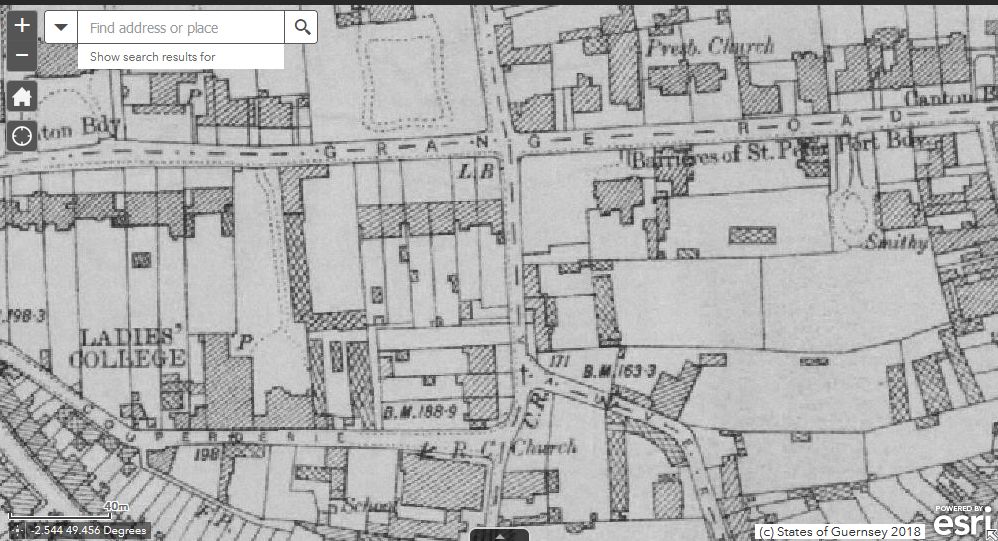
1898 Map - Brockhurst during the Victorian era of Captain Dugmore and Hon. Emily Brougham
The Honorable Emily Evelyn Brougham
Daughter of William Brougham, 2nd Baron Brougham and Vaux, and great-niece of Henry Brougham, 1st Baron Brougham and Vaux (1778–1868) — one of the most celebrated statesmen of the 19th century. As Lord High Chancellor of Great Britain, Henry Brougham played a pivotal role in passing the Reform Act 1832 and the Slavery Abolition Act 1833, helped found the University of London, reformed the court system, and gave his name to the Brougham carriage. Emily resided at Brockhurst by 1891 following the breakdown of her marriage, living on private means with her two youngest sons. She died in St Peter Port on 13 November 1919 — having outlived her estranged husband by 21 years.
The Honorable Emily Evelyn Brougham
Daughter of William Brougham, 2nd Baron Brougham and Vaux, and great-niece of Henry Brougham, 1st Baron Brougham and Vaux (1778–1868) — one of the most celebrated statesmen of the 19th century. As Lord High Chancellor of Great Britain, Henry Brougham played a pivotal role in passing the Reform Act 1832 and the Slavery Abolition Act 1833, helped found the University of London, reformed the court system, and gave his name to the Brougham carriage. Emily resided at Brockhurst by 1891 following the breakdown of her marriage, living on private means with her two youngest sons. She died in St Peter Port on 13 November 1919 — having outlived her estranged husband by 21 years.
Captain W.E.L.R. Dugmore
Recorded as residing at Brockhurst in the 1911 Census.
Captain W.E.L.R. Dugmore
Recorded as residing at Brockhurst in the 1911 Census.
The McCave Family
Purchased Brockhurst in the 1920s (William McCave, Nick's grandfather), the family stayed through WWII and beyond. German forces bombed St Peter Port on 28 June 1940 — killing 33 civilians in a raid that mistook tomato trucks for military vehicles — before invading on 30 June 1940. The Channel Islands remained under occupation for five years until 9 May 1945, making them the only part of the British Isles to be occupied during the war. The nearby Grange Lodge Hotel was requisitioned as German Civil Affairs Command headquarters. The McCave family remained at Brockhurst throughout; their seed and fertiliser expertise helped islanders cultivate vital crops during the occupation. The McCave grandmother lived at Brockhurst until 1973; Nick McCave (grandson) remained until the sale in 1974.
The McCave Family
Purchased Brockhurst in the 1920s (William McCave, Nick's grandfather), the family stayed through WWII and beyond. German forces bombed St Peter Port on 28 June 1940 — killing 33 civilians in a raid that mistook tomato trucks for military vehicles — before invading on 30 June 1940. The Channel Islands remained under occupation for five years until 9 May 1945, making them the only part of the British Isles to be occupied during the war. The nearby Grange Lodge Hotel was requisitioned as German Civil Affairs Command headquarters. The McCave family remained at Brockhurst throughout; their seed and fertiliser expertise helped islanders cultivate vital crops during the occupation. The McCave grandmother lived at Brockhurst until 1973; Nick McCave (grandson) remained until the sale in 1974.
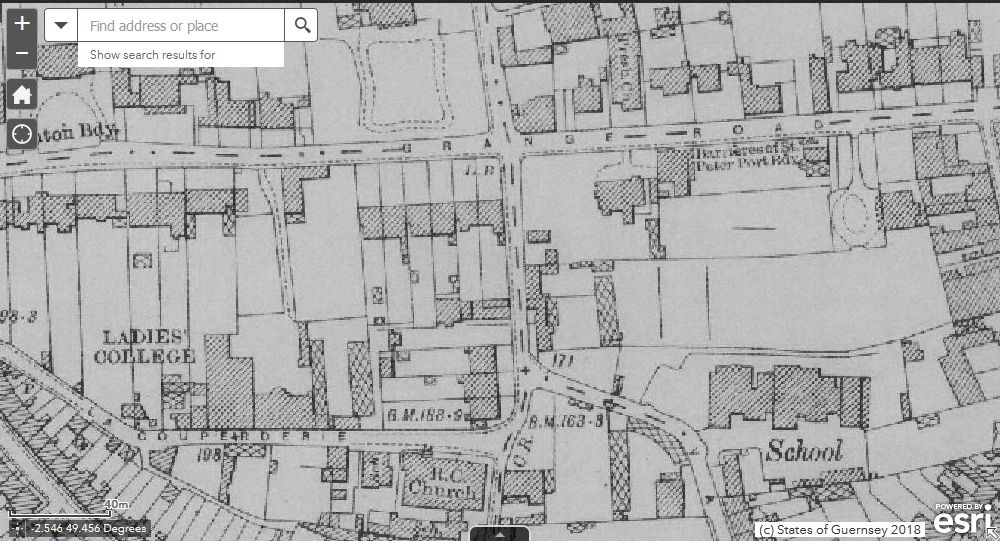
1938 Map - Brockhurst during the McCave family era, before WWII occupation
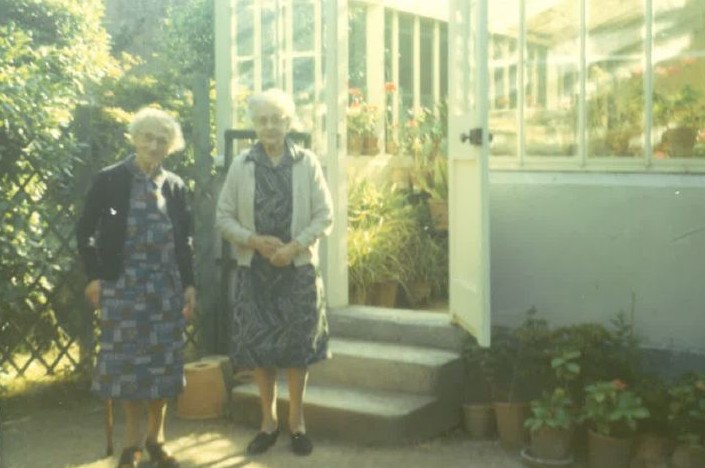
Historical photo from the McCave family era at Brockhurst
Dennis Curry & Family
Dennis Curry (1912–2001) — chairman of the Currys retail chain from 1967 to 1984, Cambridge-educated geologist, visiting professor at University College London, Fellow of the Geological Society, and major philanthropist who donated 90,000 fossil specimens to the Natural History Museum — purchased Brockhurst. Described by his peers as 'a remarkable polymath.'
Dennis Curry & Family
Dennis Curry (1912–2001) — chairman of the Currys retail chain from 1967 to 1984, Cambridge-educated geologist, visiting professor at University College London, Fellow of the Geological Society, and major philanthropist who donated 90,000 fossil specimens to the Natural History Museum — purchased Brockhurst. Described by his peers as 'a remarkable polymath.'
Florian and Trevor Carr
Eventually bequeathed Brockhurst to National Trust of Guernsey in 2000.
Florian and Trevor Carr
Eventually bequeathed Brockhurst to National Trust of Guernsey in 2000.
National Trust of Guernsey
Acquired Brockhurst (bequest from Mrs. Carr for one guinea). Work began in earnest in July 2014, undertaken by local builders CA Duquemin under the direction of architects Cresswell Cuttle & Dyke (CCD). The restoration was comprehensive: from rewiring and replumbing to painstaking repair of the historic timber roof, leadwork, flagstones, and ironmongery — elements CCD noted were 'unique because of their superior quality and quantity' compared to other historic properties. Most remarkably, workers uncovered hidden 18th-century panelling and a concealed doorway behind later additions, prompting a layout revision that revealed the original dining room entrance. A Georgian-style flat-roofed orangery replaced a later conservatory. The restored house opened for public tours in October 2015.
National Trust of Guernsey
Acquired Brockhurst (bequest from Mrs. Carr for one guinea). Work began in earnest in July 2014, undertaken by local builders CA Duquemin under the direction of architects Cresswell Cuttle & Dyke (CCD). The restoration was comprehensive: from rewiring and replumbing to painstaking repair of the historic timber roof, leadwork, flagstones, and ironmongery — elements CCD noted were 'unique because of their superior quality and quantity' compared to other historic properties. Most remarkably, workers uncovered hidden 18th-century panelling and a concealed doorway behind later additions, prompting a layout revision that revealed the original dining room entrance. A Georgian-style flat-roofed orangery replaced a later conservatory. The restored house opened for public tours in October 2015.
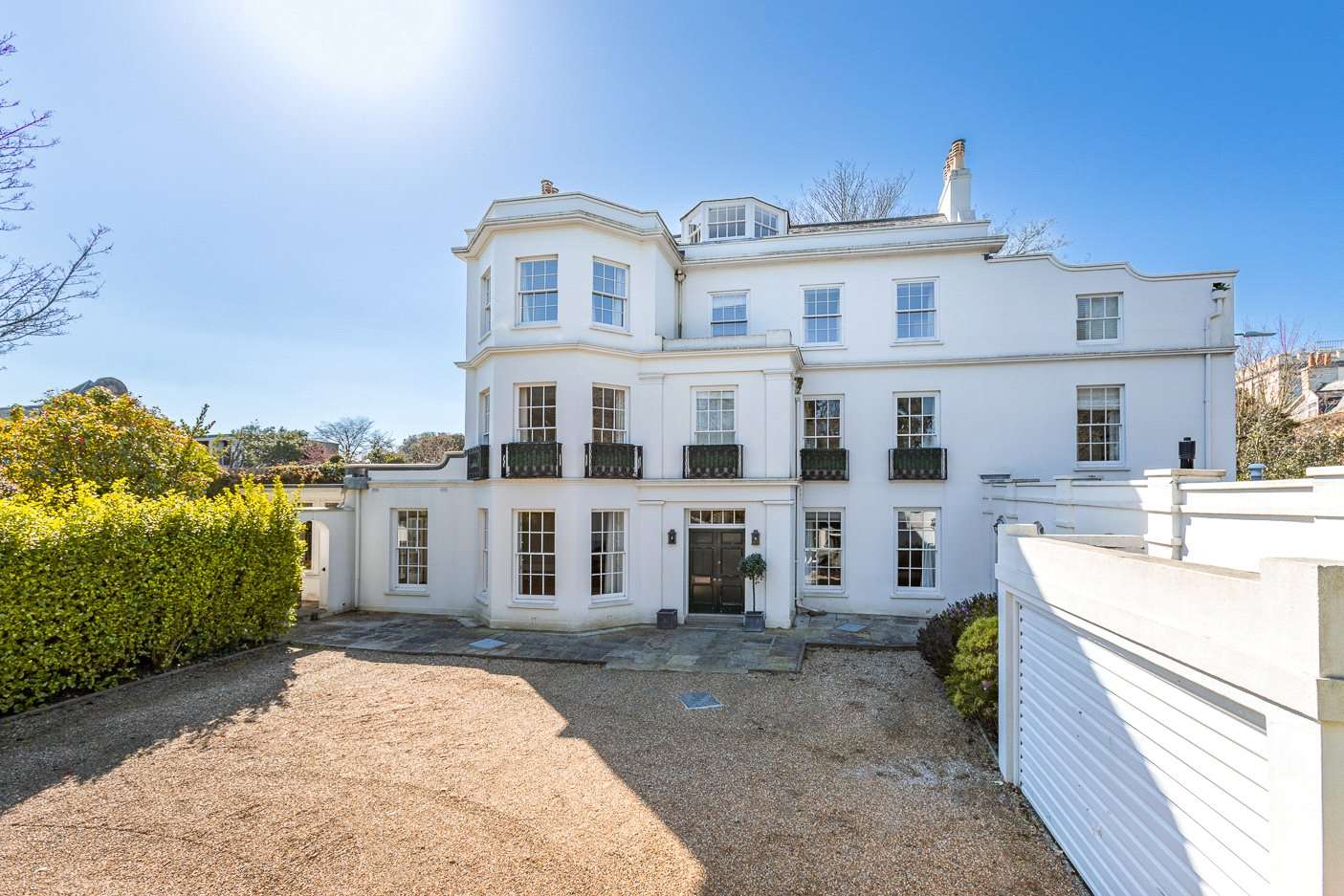
Brockhurst after the National Trust restoration (2013-2015)
Current Residents
Committed to preserving the historical integrity of Brockhurst going forward. (Brockhurst sold into private ownership).
Current Residents
Committed to preserving the historical integrity of Brockhurst going forward. (Brockhurst sold into private ownership).